Best Time to Send Marketing Emails in 2026: Ultimate Guide
What the data says about the best time to send marketing emails, how audience, industry, and campaign type change it, and how to find your own send time.

On this page
You’ve written the email, settled on a subject line, and now you’re hovering over the Send button, wondering whether now is really the right time.
So, when is the best time to send a marketing email? There’s the short answer you’ll see in almost every industry study, and then there’s the real one.
The reality is far more nuanced, and those nuances often determine whether your email gets opened or disappears into a crowded inbox.
In this article, you’ll learn what the data says, what actually influences email timing, and how to choose the best send time for your audience.
Key takeaways
- The safe default is midweek (Tuesday to Thursday), mornings between 9 AM and 12 PM, in the recipient’s local time zone.
- The best time shifts by goal: newsletters do well in the morning, promotions late afternoon to evening, and B2B mid-morning or just after lunch.
- Time zone, deliverability, and list segmentation affect results as much as the hour you pick.
- Treat benchmarks as a starting point, then A/B test and prioritize clicks and conversions over opens.
When is the best time to send a marketing email?
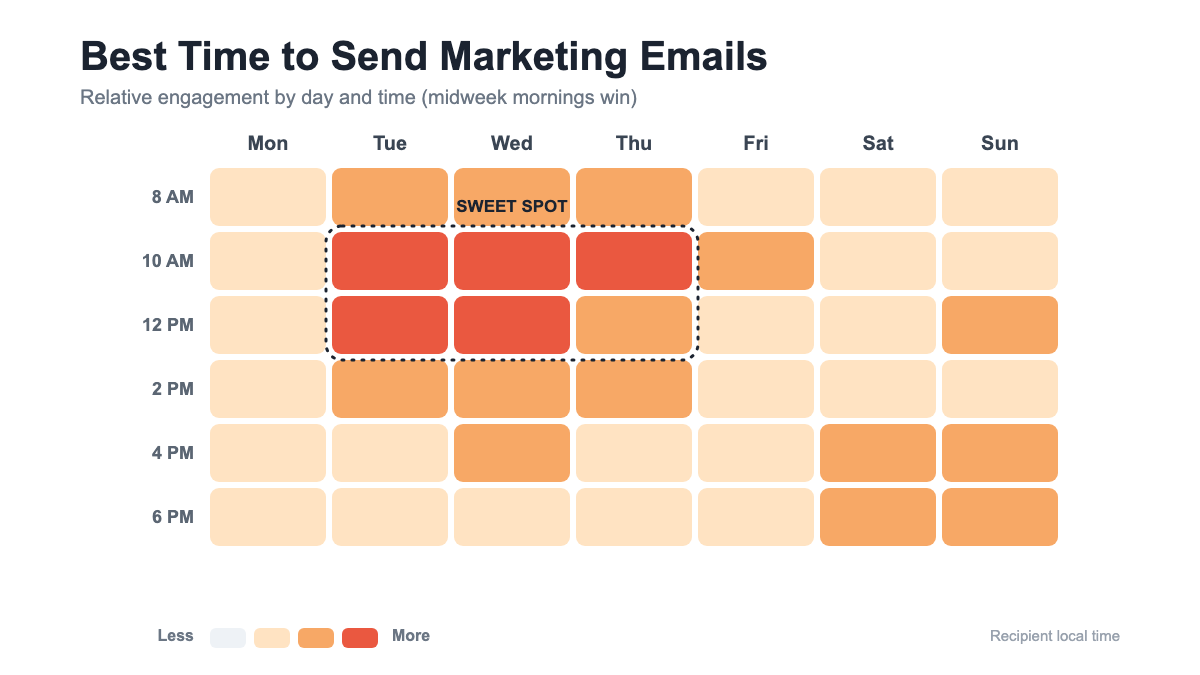
The best time to send a marketing email is generally Tuesday, Wednesday, or Thursday, between 9 AM and 12 PM, in the recipient’s local time zone. That’s the pattern you’ll see repeated across most industry studies, and it holds up reasonably well as a starting point.
But treat it as exactly that: a starting point, not a rule. The real answer depends heavily on your audience, your industry, and what you’re actually asking the reader to do.
A B2B software company and a weekend flash-sale retailer are not going to share the same ideal send window, even if both technically fall under “marketing email.”
The rest of this guide breaks down how to move from that general average toward something that actually fits your list.
What is the short answer?
If you only have time for one takeaway: send on a midweek day, in the morning, in your recipient’s own time zone, and adjust from there based on what you’re sending and to whom.
If you’re just looking for the best time to send an email without digging into all the nuance, that’s genuinely a safe default.
For a slightly more complete picture of the best day and time to send email marketing, here’s a quick reference to start with:
- Best overall: Tuesday–Thursday, 9 AM–12 PM
- Best for B2B: Tuesday or Wednesday, 9 AM–11 AM, or right after lunch
- Best for B2C: Weekday evenings (4 PM–8 PM) or weekends, depending on the product
- Best for newsletters: Weekday mornings, 8 AM–11 AM
- Best for promotions: Late afternoon to early evening, 4 PM–7 PM
Keep in mind that every one of these is a benchmark drawn from broad industry averages, not a guarantee for your specific list.
The rest of this article gets into why each best time of day for email marketing tends to work for its particular use case, and how to find your own.
Why do Tuesday, Wednesday, and Thursday perform better?
There’s a fairly intuitive behavioral reason behind the pattern of Tuesday, Wednesday, and Thursday performing better.
Monday mornings are usually spent catching up: sorting through a flooded inbox, triaging what happened over the weekend, and getting oriented for the week ahead. A marketing email competing for attention in that pile has a tougher time standing out.
Friday, meanwhile, tends to bring a different kind of distraction: people are wrapping up tasks, mentally checking out for the weekend, and less inclined to engage with anything that isn’t urgent.
That leaves the middle of the week as something of a sweet spot. Inboxes have settled down, the initial Monday scramble is over, and attention hasn’t yet drifted toward weekend plans.
It’s not a hard rule, but it’s a reasonable explanation for why the data consistently points to Tuesday through Thursday.
Best day and time by campaign type
A single “best time” makes less sense once you consider that not every email is asking the reader to do the same thing.
- A newsletter wants a few quiet minutes of attention
- A flash sale wants an impulse decision
- A nurture email wants to keep a relationship warm without demanding anything right away
- A launch wants momentum
- A re-engagement email is trying to win back someone who’s already tuned you out
Five different goals, and five different moments when each one actually lands, starting with the one built around quiet attention rather than urgency.
Newsletters and educational emails
Newsletters and other educational content tend to perform best in the morning, roughly between 8 AM and 11 AM.
This lines up with how people actually consume that kind of email: before the workday fully kicks in, during a coffee break, or while easing into their inbox before the first meeting of the day.
It’s a moment associated with learning and catching up, not urgency, which fits the tone of most newsletter content.
Promotional and sales emails
Campaigns built around driving a purchase decision tend to shift later in the day, often performing well between 4 PM and 7 PM, sometimes stretching to 8 PM, especially for B2C audiences.
This tends to align with when people have wrapped up their workday and are more open to browsing, shopping, or acting on an offer without a work task pulling their attention away.
That said, this pattern is much less reliable for B2B audiences, where evening sends can simply arrive after the reader has already logged off.
Email blasts, launches, and limited-time offers
Sending to your entire list at once, whether for a product launch or a limited-time offer, carries its own risks beyond just picking a good hour.
If you’re wondering about the best time to send email blast campaigns specifically, the honest answer is that blasts behave differently from targeted sends.
A blast sent to everyone simultaneously ignores the fact that different segments of your list engage differently, and it can put real strain on deliverability if a large volume goes out in a short window and a meaningful share of it goes unopened.
Before defaulting to a full blast, it’s worth comparing that approach against sending in smaller waves based on past behavior, such as prioritizing your most engaged segment first.
A launch email sent to the whole list at 10 AM might look efficient, but a staggered send that reaches each segment closer to when they’re actually likely to open often performs better and puts less pressure on your sender reputation.
Best send times for B2B vs B2C
Professional and personal inboxes operate on different rhythms, and that difference shows up clearly in send-time data.
So, when is the best time to send a marketing email? The answer depends on whether you’re targeting a B2B or B2C audience.
Take a look at the recommended send times below.
Best time to email business professionals
For B2B audiences, Tuesday and Wednesday mornings tend to perform best, especially between 9 AM and 11 AM. Another strong window is shortly after lunch, around 1 PM to 2 PM. Both time slots come after the initial morning rush but before people begin winding down for the day.
It’s generally worth avoiding the very start and the very end of the workday. Early morning sends compete with a full inbox of overnight messages, while late-afternoon emails risk arriving just as people are wrapping up and closing their laptops.
The ideal timing can also vary by business type. A SaaS company targeting busy professionals may see the strongest results in late morning, just before lunch creates a natural pause to check email.
Consulting and professional services firms, on the other hand, often see higher engagement shortly after lunch, when clients are back at their desks but not yet buried in afternoon meetings.
Best time for consumer audiences
Consumer audiences behave quite differently, often engaging with marketing emails in the evenings and on weekends, when they’re browsing on their own time rather than checking email between work tasks.
Sunday evening, in particular, tends to perform well in some industries, likely because people are planning the week ahead and are more receptive to deals, promotions, or new product launches.
Retail, ecommerce, and entertainment brands often see engagement patterns that differ significantly from B2B benchmarks, making audience testing especially important.
How industry and audience behavior change the ideal send time
Beyond the B2B versus B2C distinction, industry also plays a major role in determining the best time to send a marketing email. Benchmark reports can point you in the right direction, but they’re only a starting point.
The timing that works for a software company won’t necessarily work for an ecommerce retailer, a healthcare provider, or a local service business because each audience has different routines, priorities, and moments when they’re most likely to engage.
Instead of treating industry averages as fixed rules, use them as a baseline and adjust based on how your customers actually behave.
The examples below illustrate how those patterns can vary across different sectors.
Ecommerce, SaaS, local business, and media examples
While general benchmarks provide a useful starting point, industry-specific behavior often has a greater impact on email performance. The examples below show how timing can vary across different types of businesses.
| Industry | Tends to perform well | Why |
|---|---|---|
| Ecommerce | Late morning near lunch, or evenings | Shoppers browse during breaks or downtime, not typically first thing in the morning |
| SaaS | Business hours, especially mid-morning | Buyers and users are at their desks, checking email as part of the workday |
| Local business | Varies by regional routine | Engagement often follows local commuting patterns, meal times, or weekend habits specific to the area |
| Media and newsletter | Early morning | Readers often want to catch up before the day gets busy, making early sends feel timely rather than intrusive |
The pattern across all four is less about the specific hour and more about matching the email to a moment when checking it feels natural rather than like an interruption.
New subscribers vs engaged subscribers vs inactive contacts
Where someone is in their relationship with your email list also influences when they’re most likely to engage. New subscribers often open emails shortly after signing up, while the reason they joined is still fresh in their minds. That’s why welcome emails and onboarding sequences usually perform best when they’re sent immediately rather than delayed.
Engaged subscribers, who consistently open and click your emails, tend to respond well to a predictable sending cadence. Over time, they’ve become familiar with your communication schedule and are more likely to expect your messages.
Inactive subscribers require a different approach. Since they’ve already stopped responding to your usual send times, sticking to the same schedule is unlikely to change the outcome. Instead, experiment with different days, time slots, or even subject lines to see if you can re-engage them.
Time zone, deliverability, and send-time optimization
Finding the best send time is only one piece of the puzzle. Emails need to reach recipients at the right moment in their local time and make it to the inbox in the first place.
That’s why time zones, deliverability, and send-time optimization all play a critical role in campaign performance.
Why does the recipient’s local time matter?
If your email list spans multiple regions, sending every campaign at the same time doesn’t mean everyone receives it at the same moment.
An email sent at 10 AM from a New York office reaches someone in California at 7 AM, long before many people have started checking their inbox.
That’s why scheduling emails based on each recipient’s local time, rather than your own, often leads to higher open rates and better overall engagement.
For geographically diverse audiences, local-time sending is one of the simplest ways to improve campaign performance.
How deliverability affects the “best time”?
Timing and deliverability are related, but they’re not the same problem. You can send an email at the ideal time and still see disappointing results if it never reaches the inbox.
A cold or outdated list, poor domain reputation, sending too frequently, or failing to segment your audience can all lower engagement, regardless of when you hit send.
Before assuming that timing is the issue, check whether deliverability problems are affecting your results behind the scenes.
How to find the best send time for your own list?
Industry benchmarks can help you make an educated guess, but your own audience data is the most reliable source of truth.
The best way to find your ideal send time is to create a simple testing process, measure the results, and refine your approach over time.
A simple A/B testing framework
You don’t need a complex testing setup to find patterns in your audience’s behavior. Start by choosing two potential send days and two time windows based on the benchmarks and insights discussed earlier.
Send the same email, with the same subject line, content, and offer, to comparable segments of your list. The only variable that should change is the send time. This helps you understand whether timing is actually influencing performance rather than another factor.
After each test, wait for a consistent analysis window, such as 48 to 72 hours, before comparing results. Once you identify a stronger performer, run another test with a new variation instead of treating the first result as a permanent rule.
Which metrics matter most?
Open rate alone can be an unreliable metric for deciding the best send time, especially as privacy features and tracking limitations make open data less precise.
Instead, prioritize metrics that are closer to your actual business goal, such as clicks, conversions, revenue per send, replies, or unsubscribe rates.
The right metric depends on the purpose of the campaign: a newsletter may focus more on clicks and engagement, while a promotional email should be evaluated based on conversions and revenue generated.
Ultimately, the best send time isn’t the one that gets the most opens. It’s the one that helps your campaigns achieve the outcome you’re aiming for.
Common mistakes when choosing email send times
Even with the right data and testing process, it’s easy to fall into common mistakes when choosing an email send time. Many teams rely too heavily on general benchmarks, overlook the context behind audience behavior, or optimize for opens instead of meaningful actions.
Understanding these mistakes helps you avoid false conclusions and build a send-time strategy based on your own customers, not just industry averages.
Copying generic benchmarks without testing
Benchmarks like “Tuesday at 10 AM” are a reasonable place to start, not a final answer. Applying one blindly, without considering your audience, offer, sending frequency, or channel, can lead you to adopt a schedule that works well for someone else’s list but performs poorly for yours.
Ignoring intent, device, and buying context
The best send time also depends on where, how, and why someone is reading your email, as well as what you want them to do after opening it.
A quick update designed to be skimmed on a phone during a commute has a different ideal moment than an email asking someone to review a proposal or book an appointment, which requires more time and attention.
The right timing should match not only your audience’s habits but also the level of attention and action your email requires.
Why send-time optimization should be automatic, not manual
Everything covered so far describes a practical manual process: benchmark, test, measure, and adjust. It’s the right starting point, and for many teams, it may be enough.
The challenge appears when you try to apply that process at scale. Testing different days, times, segments, and metrics works when you’re running a limited number of campaigns.
Doing it continuously, for every customer and every campaign, while adapting to changing behavior over time, isn’t realistic for a human team.
This is where an AI decisioning layer becomes valuable. Instead of choosing one fixed “best time” for your entire list, the system learns the ideal send time for each individual customer and keeps adjusting as new behavioral data comes in.
The goal isn’t simply to increase opens, but to optimize for actual conversions. Platforms like RevBridge apply this approach to CRM and lifecycle marketing, automating decisions that would be difficult to manage manually.
One send time doesn’t fit your whole list
Even a well-tested “best time” is still an average, and averages hide a lot. Some contacts are more likely to engage early in the morning, while others respond better late at night or on weekends.
This connects directly back to the earlier point about new, engaged, and inactive subscribers behaving differently.
A single send time, however carefully chosen, can never fully account for those differences. Per-contact timing closes that gap by adapting to each subscriber’s behavior instead of forcing everyone into the same schedule.
From A/B testing to continuous, real-time learning
The manual A/B framework described earlier works, but it is inherently sequential: test two days, compare results, apply the winner, and repeat as behavior changes.
A decisioning system built for this problem can run multiple send-time experiments in parallel and continue adjusting automatically as it learns, without waiting for each test cycle to end before applying what it has learned.
An outcome-based pricing model follows the same logic. Instead of paying based on the number of emails sent, companies pay for conversions, keeping optimization focused on the result that matters most: reaching each customer at the moment they’re most likely to take action.
Testing days and times manually gets you a good average.
RevBridge finds the right moment for each customer automatically, and keeps adjusting as behavior changes.
FAQ
What is the 3 email rule?
The 3 email rule is a lightweight follow-up sequence: send an initial email, a reminder a few days later if there’s no response, and a final follow-up shortly after before moving the contact to a different track. It avoids going silent too early or over-emailing someone unresponsive.
What is the 30/30/50 rule for cold emails?
The 30/30/50 rule is a structural guideline for cold outreach: roughly 30% of the email should focus on personalization, 30% on a clear value proposition, and the remaining 50% on building toward a specific, low-friction call to action.
Does the best time to send a marketing email depend on the time zone?
Yes. Time zone significantly affects send-time performance, especially for lists spanning multiple regions. An email timed well for one zone can arrive far too early or late for another recipient, which is why sending by each person’s local time tends to outperform one fixed time for the whole list.
 21 min read
Remarketing: What It Is, How It Works, and How to Run a Campaign
Learn what remarketing is, how it works, the main types, metrics, and best practices to create more effective campaigns.

 20 min read
What Is Martech? Meaning, Stack, and Tools in 2026
Learn what martech is, how it works in practice, and how AI, automation, and data help companies optimize marketing results.
 16 min read
What is CRM (Customer Relationship Management)?
What CRM is, how it works, the four types, the benefits for sales, marketing, and support, and how to choose…

 13 min read
What Is a Good Open Rate for Email Marketing in 2026?
What a realistic email open rate looks like in 2026, how it's calculated, why benchmark sources disagree, and which metrics…