Remarketing: What It Is, How It Works, and How to Run a Campaign
Learn what remarketing is, how it works, the main types, metrics, and best practices to create more effective campaigns.
On this page
Have you ever visited a website, looked at a product, closed the tab without buying, and then, over the following days, started seeing that same product on other sites or social networks? That is remarketing in action.
If you got here searching for “what is remarketing”, know that this strategy goes far beyond “chasing” users with ads.
The goal is to re-engage people who have already shown interest in the brand, making communication more relevant and increasing the chances of conversion.
In this article, you will understand how remarketing works, what the main types are, when to use it, and how to create more effective campaigns, from planning to analyzing the results.
Key takeaways
- Remarketing means reaching people who have already interacted with your brand, using real behavioral data instead of targeting a cold audience.
- Remarketing and retargeting are treated as synonyms in the market: the difference is one of origin, not of concept.
- With browsers restricting third-party cookies, remarketing increasingly depends on first-party data collected with consent.
- High frequency with falling CTR and conversion rate is a sign of audience saturation, not lack of interest.
- Manual playbooks work up to a point: as the customer base grows, deciding channel, message, and timing per customer requires data-driven automation.
What is remarketing?
Remarketing is the strategy of reaching people who have already interacted with your brand, website, product, content, or communication channel, with the goal of bringing them back to complete an action they did not finish.
It can be someone who visited a product page and did not buy, who abandoned a cart, who downloaded a resource but did not fill in the contact form, or even a long-time customer who has not purchased in a while.
The difference between remarketing and a regular campaign lies exactly at this point: you are not trying to reach a cold audience that has never heard of your company.
You are working with real behavioral data, collected from an interaction that has already happened, to decide who should receive the next message, with which content, and at what moment.
It is this behavioral data foundation that makes remarketing, in general, more efficient than campaigns focused only on acquisition.
Read more: What Is Martech? Meaning, Stack, and Tools in 2026
Are remarketing and retargeting the same thing?
Most of the time, remarketing and retargeting are the same thing. People who search “what is retargeting” separately from “what is remarketing” tend to find practically identical answers.
In the market, the two terms are usually treated as synonyms, and you can find professionals and tools using one or the other to describe exactly the same thing: reaching people who have already been in contact with the brand.
Still, it is worth noting a small difference in origin to understand why the terms coexist. Historically, retargeting became more associated with paid media, specifically ads that “chase” a person after they leave the website.
Remarketing has an origin tied to Google Ads, which named its own re-engagement feature that way, and the term ended up becoming popular in a broader sense, also covering email, SMS, and other owned channels.
In day-to-day practice, however, the choice of one term or the other varies more by tool and by professional than by any major difference in concept.
How does remarketing work in practice?
Behind every remarketing campaign there is a relatively simple mechanism: someone performs an action, that action is recorded, and the person joins a group that will receive a specific communication at another moment or on another channel.
What changes from one strategy to another is how that recording happens and which data feeds that list.
It is worth highlighting that the 2026 landscape is different from what it was a few years ago. Stricter privacy restrictions, browsers blocking third-party cookies, and growing consent requirements have made remarketing depend more and more on first-party data, that is, information collected directly from your own base, with the user’s proper consent, instead of relying only on cross-site tracking done by third parties.
Which data and triggers activate a campaign?
A remarketing campaign can be triggered by different types of behavior, and each trigger tends to make more sense in a specific context.
A visit to a specific page already indicates interest in a topic or product, even if in a broad way.
In e-commerce, viewing a product without purchasing is one of the most used triggers, and cart abandonment is even stronger, since the person has shown explicit purchase intent.
Outside the direct sales funnel, time spent on the site can also indicate engagement, even without a concrete recorded action, as can an incomplete form submission, which tends to be a valuable signal of qualified interest.
Opening an email without clicking is another useful trigger, ideal for firing a complementary message. A previous purchase, in turn, works as a natural trigger for repeat-purchase campaigns.
And, on some platforms, even social media engagement, like liking or commenting on a post, can feed remarketing audiences.
The role of cookies, pixels, and customer lists
There are, basically, three ways to track customer behavior. Browser-based tracking uses cookies to identify visitors and their behavior on a website, but this method has been losing strength as browsers restrict third-party cookies.
Events fired via tag manager (such as Google Tag Manager) capture specific actions, like button clicks or page views, allowing you to build well-segmented audiences.
And lists based on email or CRM, built from your own contact base, tend to be more stable, since they do not depend on third-party tracking.
An important caveat here: remarketing does not depend only on third-party cookies, as many people still think.
The trend is exactly the opposite, a growing dependence on first-party data, collected with explicit consent.
This requires extra attention to data protection laws such as Brazil’s LGPD, to the site’s cookie policy, and to the quality of the database used, because a poorly maintained list, or one collected without proper consent, is both a legal and a reputational risk.
Why is remarketing important for conversion and retention?
Most people do not buy, or convert, on their first visit to a website. And that is completely normal: there is price research, comparison with competitors, unresolved doubts, and simple lack of time at that moment.
Remarketing exists precisely to recover demand that would otherwise be lost. Beyond recovering conversions, it helps strengthen brand recall, reduces media waste (since it is targeted at a qualified audience), and tends to shorten the decision cycle, since it keeps the brand present while the person is still considering the purchase.
These benefits can vary depending on the business model:
- E-commerce: recover abandoned carts, recommend related products, promote offers, and encourage repeat purchases.
- Service companies: stay in touch with visitors who requested a quote, downloaded a resource, or showed interest, but have not yet hired the service.
- B2B businesses: nurture leads during longer sales cycles with educational content, case studies, demos, and invitations to events or webinars.
- Local businesses: encourage customers to return with personalized offers, seasonal campaigns, loyalty programs, or announcements of new products and services.
Remarketing also plays an important role in customer retention. After the first purchase, it can be used to strengthen the relationship, encourage repeat purchases, present new products, and increase Customer Lifetime Value.
When well segmented and aligned with the journey stage, remarketing stops being just a strategy to recover lost sales and starts contributing to building longer-lasting, more profitable relationships.
At which journey stages does it deliver the most results?
Remarketing can deliver results at different stages of the customer journey, as long as the message is adapted to each person’s moment. Instead of showing the same ad to everyone, the strategy should consider the level of interest and how close the person is to converting.
- Top of funnel (discovery): for those who have already visited the site or consumed some content, remarketing can reinforce the brand’s presence with educational materials, articles, videos, or other content that helps the user move forward in the journey.
- Middle of funnel (consideration): at this stage, the goal is to strengthen trust and help with decision-making. You can use customer testimonials, case studies, product comparisons, or demos to show the value of the solution.
- Bottom of funnel (decision): when the customer is close to converting, remarketing can encourage the purchase with personalized offers, abandoned-cart reminders, free trials, discount coupons, or limited-time special conditions.
- Post-sale and loyalty: remarketing can also be used after the purchase to recommend complementary products, encourage a new purchase, announce launches, or strengthen the relationship with existing customers.
The more aligned the message is with the journey stage, the better the results tend to be. A person who is still researching needs information and trust, while someone ready to buy expects an incentive to make the decision. This personalization makes campaigns more relevant and increases the chances of conversion.
Check out: What Is a CRM and What Is It For?
Types of remarketing by channel
Remarketing can be applied across different channels, and each format serves specific goals within the marketing strategy. The choice depends on the audience’s behavior, the stage of the buying journey, and the channels the company uses to communicate.
Get to know the main types of remarketing and when each one tends to deliver the best results.
Display remarketing
Display remarketing uses visual ads shown on websites, apps, and other placements across media platforms’ partner networks. The goal is to keep the brand present in the consumer’s mind after a site visit or another relevant interaction.
This format is especially suited to reinforcing brand awareness and encouraging the return of users who showed interest but have not yet converted.
Creatives can highlight recently viewed products, special offers, launches, or messages personalized according to the visitor’s behavior.
Advantages:
- Increases brand recall;
- Reaches users while they browse other sites and apps;
- Allows ads to be personalized according to the audience’s interest.
Limitations:
- Excessive frequency can cause fatigue and reduce the campaign’s effectiveness;
- Tends to show lower purchase intent than search-based formats.
That is why controlling ad frequency and refreshing creatives periodically is essential to avoid saturation.
Search remarketing
In search remarketing, ads appear when a person who has already interacted with the company searches again for related terms on search engines.
Since the person is showing renewed interest in the topic, this format usually captures higher purchase intent than campaigns aimed at entirely new audiences.
For example, someone who visited a health-insurance plans page and, days later, searches for the service again may see a personalized ad from the company during that new search.
Advantages:
- Reaches users at a moment of high intent;
- Improves media investment efficiency;
- Allows bids and messages to be adjusted for audiences that already know the brand.
Limitations:
- Depends on a sufficient volume of related searches;
- Only works when the user returns to the search engine.
Email and CRM remarketing
Email remarketing uses the company’s own data to re-engage customers and leads throughout the journey. Among the most common flows are:
- Abandoned-cart recovery;
- Interrupted-browsing reminders;
- Post-sale campaigns;
- Complementary product recommendations;
- Reactivation of inactive customers.
Since it uses the company’s own contact base, this format allows a high level of personalization and tends to deliver good results when campaigns are segmented according to the customer’s behavior and history.
Advantages:
- Highly personalized communication;
- Less dependence on paid media platforms;
- Excellent for retention and loyalty.
Limitations:
- Depends on a qualified contact base;
- Requires consent to send communications and a consistent segmentation strategy.
Social media and messaging remarketing
Social networks also offer remarketing features to reach users who have already interacted with the brand through the website, app, videos, or the company’s profiles.
On platforms like Meta Ads, you can create custom audiences to show specific ads according to the user’s behavior.
Messaging apps, such as WhatsApp, can be used for re-engagement in specific scenarios, like cart recovery, quote follow-ups, or communication with customers who have authorized that contact.
Although both are part of a remarketing strategy, it is important to distinguish paid ads from automations and messages sent through owned channels.
Advantages:
- Close, personalized communication;
- Ability to combine paid campaigns with owned channels;
- Good potential for recovering opportunities and building loyalty.
Limitations:
- Must respect privacy and consent rules;
- Excessive outreach can harm the customer experience.
Regardless of the chosen channel, the success of remarketing depends on smart segmentation and messages that are relevant to each stage of the journey.
The more contextualized the communication, the greater the chances of recovering the user’s interest and turning new interactions into conversions.
How to run a remarketing campaign step by step?
An effective remarketing campaign goes beyond installing a pixel and creating ads. You need to define clear goals, segment the audience correctly, personalize communication, and track results throughout the campaign.
Although settings vary between platforms, the basic structure usually follows the same steps.
Define goal, audience, and recency window
The first step is defining which result the campaign should deliver. Remarketing can be used for different goals, such as:
- Recovering abandoned carts;
- Generating new leads;
- Encouraging the purchase of a product or service;
- Driving repeat purchases;
- Increasing brand awareness.
Next, create audiences based on user behavior. Instead of grouping all visitors together, segment them according to the level of interest shown.
For example, someone who visited a product page usually has a different intent than someone who only reached the home page.
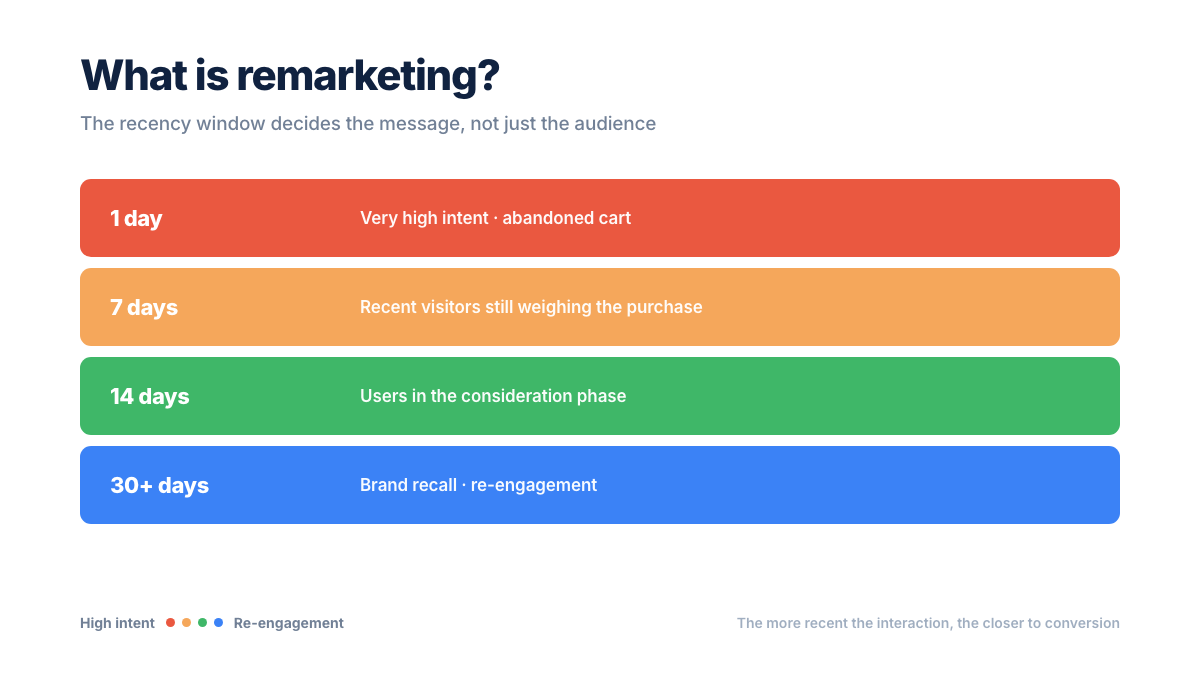
It is also important to define the recency window, that is, how long ago the interaction with the brand happened. A visitor from the last 7 days tends to be closer to converting than someone who visited the site 90 days ago.
A common segmentation is:
- 1 day: users with very high intent, like those who abandoned a cart.
- 7 days: recent visitors who are still weighing the purchase.
- 14 days: users in the consideration phase.
- 30 days or more: brand-recall or re-engagement campaigns.
Create offers and messages aligned with behavior
After defining the audience, adapt the communication to each segment’s behavior.
Someone who viewed a product can receive ads highlighting its main benefits or customer reviews.
Someone who abandoned a cart can be reached with a purchase reminder, shipping information, or a special condition, when it makes sense for the strategy.
In B2B journeys, remarketing can also promote demos, case studies, webinars, or in-depth resources to help the lead move forward in the decision.
The more personalized the message, the greater the chances of reawakening the user’s interest.
Set up exclusions to avoid wasting budget
A remarketing campaign also depends on knowing who should not receive the ads.
Excluding the wrong audiences avoids wasted budget, improves the user experience, and makes the strategy more efficient.
Some examples include:
- Customers who have already completed the purchase;
- Users who have shown no interest in the solution;
- Leads disqualified by the sales team;
- People who have already reached the frequency cap defined for the campaign.
Beyond exclusions, it is worth tracking metrics like conversion rate, cost per acquisition (CPA), return on investment (ROI), and ad frequency.
These indicators help identify optimization opportunities and ensure the campaign keeps delivering results over time.
Remarketing examples by business scenario
Remarketing can be adapted to different goals and business models. Although the logic is the same (re-engaging people who have already interacted with the brand), campaigns vary according to the customer journey and the expected result.
Here are some application examples.
Remarketing for e-commerce
Imagine that a person visits an online store, views a pair of sneakers, adds the product to the cart, and leaves without completing the purchase.
A remarketing strategy can follow this sequence:
- Up to 24 hours: an ad showing exactly the viewed product to reinforce interest.
- Between 3 and 7 days: an abandoned-cart email with product images and a reminder to complete the purchase.
- After 7 days: a campaign with customer reviews, the store’s differentiators, or a commercial condition, like free shipping or a discount, if it makes sense for the strategy.
In this scenario, metrics like cart recovery rate, conversion, cost per acquisition (CPA), and return on investment (ROI) help evaluate the campaign’s performance.
Remarketing for lead generation
Consider a service company whose visitor lands on a landing page, learns about the solution, but leaves without filling in the form.
Instead of immediately insisting on conversion, the company can use remarketing to reduce objections and build trust.
A possible sequence includes:
- Ads with customer testimonials;
- Promotion of case studies;
- Educational content related to the service;
- An invitation to a demo or free consultation.
As the user interacts with these materials, the communication can evolve until the moment they are more prepared to become a lead.
Remarketing for repeat purchase and loyalty
Remarketing can also be used after the conversion to deepen customer relationships and drive new purchases.
For example, a cosmetics store may identify that a certain product usually lasts about two months. Close to that period, the company can start a remarketing campaign offering a replacement or suggesting complementary products.
A SaaS company, in turn, can use the strategy to announce new platform features, encourage plan upgrades, or remind the customer about their subscription renewal.
In these cases, the focus shifts from the first conversion to increasing Customer Lifetime Value (LTV), repeat purchase rate, and customer retention.
Metrics to measure whether remarketing is working
Evaluating a remarketing campaign goes far beyond checking how many sales it generated. Success depends on the goal defined at the start of the strategy.
While some campaigns aim to recover abandoned carts, others focus on increasing brand awareness, generating leads, or driving new purchases.
That is why the ideal is to track indicators that show media efficiency as well as business impact and the quality of the audience reached.
Main KPIs to track
The most important indicators vary according to the campaign’s goal, but some are present in most remarketing strategies.
- CTR (Click-Through Rate): measures the percentage of people who clicked on the ad. It helps evaluate whether the message and creative spark interest.
- CPC (Cost per Click): indicates how much each click costs. It is useful for analyzing media efficiency and comparing campaigns.
- CPA (Cost per Acquisition): shows how much was invested to generate a conversion. It is one of the main indicators for evaluating the campaign’s profitability.
- ROAS (Return on Ad Spend): measures revenue generated relative to ad investment, essential for sales-focused campaigns.
- Conversion rate: indicates the percentage of users who performed the expected action, like a purchase, sign-up, or quote request.
- Reach and frequency: show how many people were reached and how many times each user saw the ads. These indicators help identify over- or under-exposure.
- Assisted revenue: evaluates remarketing’s share in conversions that happened after other journey interactions, even when it was not the last touchpoint.
- Site return rate: indicates how many users returned to the site after being reached by remarketing campaigns.
- Recovered carts: measures how many abandonments were converted into sales after remarketing actions.
- Repeat purchase rate: important for retention-focused campaigns, it shows how many customers made a new purchase in a given period.
Tracking these KPIs offers a more complete view of the strategy’s performance and makes it easier to spot optimization opportunities.
How to interpret high frequency and performance drops?
A remarketing campaign does not always lose performance because the audience lost interest. In many cases, the problem lies in how the campaign was configured.
If frequency is too high and indicators like CTR and conversion rate start to fall, it is a sign the audience may be saturated. Showing the same ad repeatedly tends to reduce interest and increase wasted budget.
Other factors can also hurt results, such as:
- Creatives that stay the same for too long;
- Broad or poorly qualified segmentations;
- Remarketing windows that are too long, reaching users when interest has already faded;
- Offers that are not relevant to the journey stage.
In these situations, some actions can help recover performance:
- Refresh ads and creatives periodically;
- Review audience segmentation;
- Test different recency windows;
- Adjust ad frequency;
- Personalize offers and messages according to user behavior;
- Run A/B tests to identify which combinations deliver the best results.
More than tracking isolated numbers, the success of remarketing depends on analyzing indicators together.
It is this integrated view that lets you understand not only what happened, but also why the campaign performed a certain way and which adjustments can deliver better results.
Common mistakes in remarketing campaigns
Remarketing can significantly increase conversion rates when done well. However, some configuration and segmentation mistakes can hurt results, increase campaign costs, and harm the user experience.
Knowing these pitfalls is essential to creating more effective, relevant campaigns.
Reaching the right person with the wrong message
One of the most common mistakes is getting the audience right but getting the communication wrong.
Not everyone is at the same journey stage. Someone who only visited a product page needs a different approach than someone who abandoned a cart or has already made a purchase. When everyone receives the same message, campaign performance tends to drop.
Some examples include:
- Offering a discount to customers who just bought the product;
- Showing conversion ads to users who are still getting to know the brand;
- Insisting on the same creative for weeks with an audience that has already been reached many times;
- Promoting products the customer already bought, when it would make more sense to suggest complementary items.
To avoid this problem, segment audiences according to user behavior, personalize creatives, and periodically review ad frequency. The more relevant the message is to each profile, the higher the chances of conversion tend to be.
Ignoring privacy, consent, and data governance
Another frequent mistake is treating remarketing only as a media strategy, without considering the requirements around the use of personal data.
With regulations such as Brazil’s General Data Protection Law (LGPD) and changes in browser and platform privacy policies, it has become essential to ensure data collection and processing are done transparently and with the user’s proper consent.
Additionally, an outdated or poorly organized database can compromise segmentation, generate less relevant campaigns, and make it harder to measure results.
Some good practices include:
- Using a clear, up-to-date cookie policy;
- Collecting and recording consent when necessary;
- Keeping the contact base clean and up to date;
- Regularly reviewing segmentation rules;
- Adopting tools and processes compatible with privacy requirements.
More than meeting legal obligations, good data governance contributes to more precise campaigns, improves the customer experience, and strengthens trust in the brand.
How to automate remarketing via email, SMS, and WhatsApp?
Remarketing on owned channels, such as email, SMS, and WhatsApp, usually starts with simple rules: sending an abandoned-cart reminder, recovering an interrupted browsing session, or offering a discount a few days after a site visit.
This approach works well, especially in smaller operations. The challenge appears as the customer base grows and the journey becomes more complex.
Manually defining which channel to use, which message to send, when to make contact, and how often starts to require an ever-growing volume of adjustments and monitoring.
An alternative that has been gaining ground is the use of artificial intelligence to support these decisions.
Instead of applying the same playbook to every contact, AI takes part in analyzing each customer’s behavior and continuously decides which channel, message, and moment have the highest probability of generating a conversion.
RevBridge is an example of this model, operating on top of the existing operation to optimize remarketing campaigns without replacing the tools the company already uses.
Why manual remarketing playbooks lose efficiency as the base grows
A large share of remarketing automations is built with fixed triggers. For example:
- If the customer abandoned the cart, send an email after one hour;
- If there is no open, send another email two days later;
- After five days, send an offer via SMS.
These flows work and remain important. However, they start from the premise that all customers will respond the same way.
As the base grows, keeping dozens or hundreds of playbooks up to date becomes increasingly hard to do.
Old rules stop reflecting current consumer behavior, campaigns start competing with each other, and problems like excessive frequency and falling engagement become more common, exactly as we saw in the campaign optimization section.
From fixed triggers to real-time decisions per customer
Instead of defining in advance which message each user should receive, an AI-based approach allows these decisions to be made continuously.
A decision engine can evaluate each customer’s history, identify behavior patterns, and test different combinations of channel, message, and timing to discover which ones deliver the best results.
In practice, this means two customers who abandoned the same cart can receive completely different approaches.
One may respond better to an email sent the next morning, while the other is more likely to convert after a WhatsApp message or an SMS at a different time.
Since this intelligence uses data already available in systems like CRMs, e-commerce platforms, and automation tools, there is no need to rebuild the entire operation to start optimizing campaigns.
Defining playbooks, testing offers, and reviewing campaign frequency works up to a point.
RevBridge goes beyond the manual playbook.
It decides, for each customer, which channel to use, which message to send, and the best moment to make contact, charging per conversion, not per send.
FAQ
What is remarketing and how does it work?
Remarketing is a strategy that lets you reach people who have already interacted with a brand, such as website visitors, customers, or leads. It can be done through ads, email, SMS, WhatsApp, and other channels to encourage conversion, repeat purchases, or loyalty.
How do you do remarketing?
To create a remarketing campaign, you need to define the goal of the action, segment the audience based on behavior, develop personalized messages, configure contact frequency, and track indicators like conversion rate, CPA, ROAS, and site return rate to optimize results.
What is the difference between remarketing and retargeting?
Although the terms are often used as synonyms, retargeting usually refers to paid media campaigns that show ads to users who have already interacted with the brand. Remarketing is a broader concept that also includes actions on owned channels, such as email, SMS, and WhatsApp.
How do you automate remarketing via email and WhatsApp?
Automation can be done through CRM and marketing automation platforms, using triggers like cart abandonment, interrupted browsing, or post-purchase. AI-based solutions, like RevBridge’s, also let you optimize these campaigns by automatically deciding which channel, message, and timing have the highest probability of generating a conversion for each customer.
 20 min read
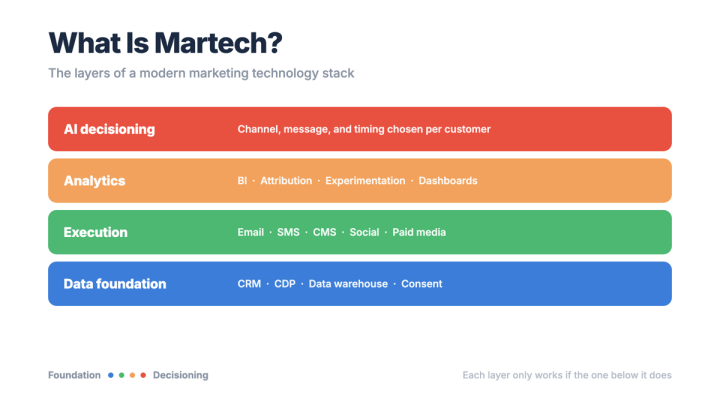
What Is Martech? Meaning, Stack, and Tools in 2026
Learn what martech is, how it works in practice, and how AI, automation, and data help companies optimize marketing results.

 15 min read
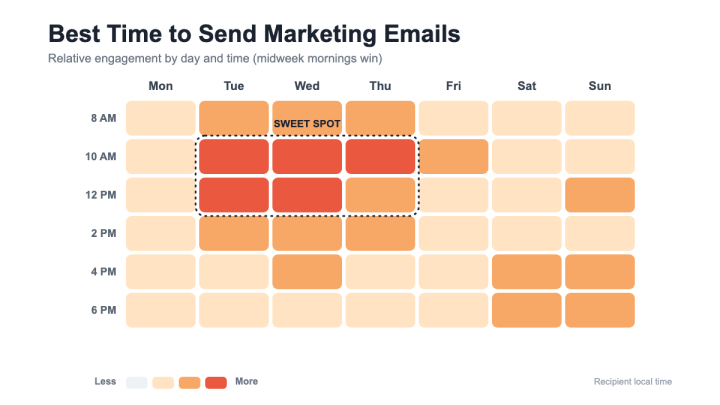
Best Time to Send Marketing Emails in 2026: Ultimate Guide
What the data says about the best time to send marketing emails, how audience, industry, and campaign type change it,…

 16 min read
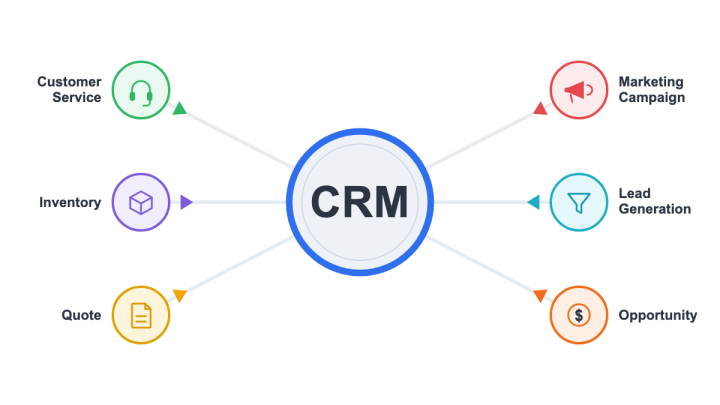
What is CRM (Customer Relationship Management)?
What CRM is, how it works, the four types, the benefits for sales, marketing, and support, and how to choose…

 13 min read
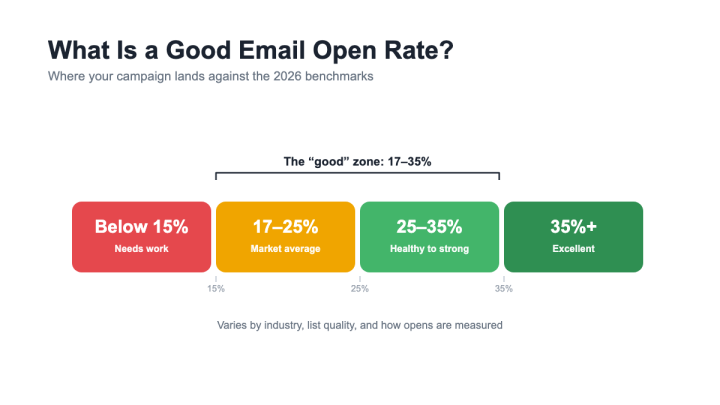
What Is a Good Open Rate for Email Marketing in 2026?
What a realistic email open rate looks like in 2026, how it's calculated, why benchmark sources disagree, and which metrics…