What Is Martech? Meaning, Stack, and Tools in 2026
Learn what martech is, how it works in practice, and how AI, automation, and data help companies optimize marketing results.
On this page
Marketing technology has become a critical part of modern marketing operations. As companies manage more channels, customer data, and digital interactions, martech helps teams automate processes, personalize experiences, and measure performance more effectively.
Short for marketing technology, martech refers to the tools, platforms, and systems used to plan, execute, and optimize marketing activities, from CRMs and automation platforms to analytics, AI solutions, and integrated data ecosystems.
In this article, you’ll learn what is martech, how a martech stack works, the main tools involved, and how companies are using these technologies to improve marketing results in 2026.
Key takeaways
- Martech is the software, platforms, integrations, and processes marketers use to plan, execute, automate, measure, and optimize campaigns.
- A martech stack is the architecture behind a marketing operation, not a list of subscriptions: how data moves between systems and how teams act on it.
- Martech manages customer relationships across the lifecycle; adtech buys and delivers paid media. They increasingly connect, but solve different problems.
- In 2026 the trend is fewer tools and more integration, with AI moving from content generation to continuous decisioning on top of the existing stack.
What is martech?
Martech is short for marketing technology: the software, platforms, integrations, and processes marketers use to plan, execute, automate, measure, and optimize their campaigns.
It covers everything from the CRM that stores your customer records to the automation tool that sends a welcome email the moment someone signs up, and the analytics dashboard that tells you whether any of it actually worked.
That definition covers the basics, but it undersells how much the category has expanded. In 2026, martech isn’t just a set of standalone tools bolted onto a marketing team’s workflow.
AI, automation, and better data infrastructure have turned it into something closer to the operating system marketing runs on, deciding not just how a campaign gets built, but increasingly, how it gets executed and adjusted in real time.
What does “martech” mean, and where did the term come from?
Martech is a portmanteau of “marketing” and “technology”. The term itself is straightforward, but its usage has shifted depending on context.
It gained real traction in the marketing world once software began to eat into functions that used to be entirely manual: segmenting audiences, scheduling campaigns, tracking performance.
As that shift accelerated through the 2010s, “martech” became the shorthand for the category, distinct from “adtech,” which focuses specifically on paid media.
You’ll see the term used in slightly different ways depending on the context. In educational content, it usually refers to the broader discipline of using technology to support marketing.
In the SaaS industry, it often refers to the vendors themselves, the companies building CRMs, marketing automation platforms, CDPs, and analytics solutions.
Within marketing teams, however, “our martech” usually means the specific stack of tools the organization uses and how those tools work together to support its marketing operations.
How has martech evolved by 2026?
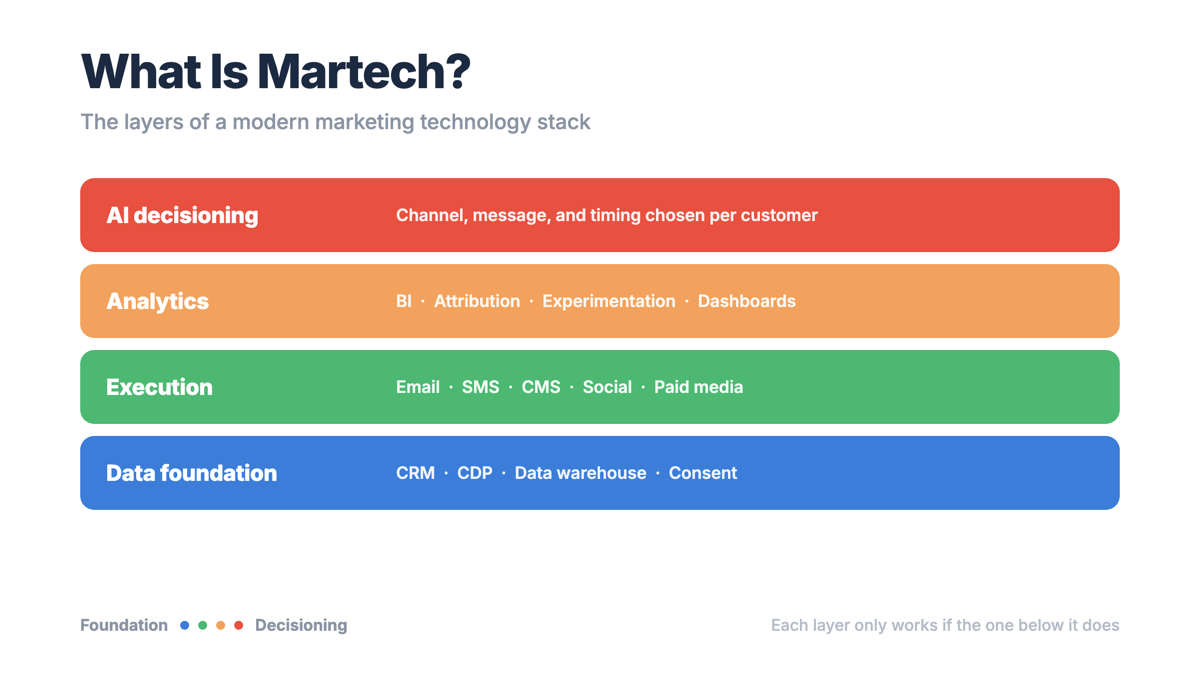
By 2026, martech has evolved from a collection of specialized tools into connected ecosystems built around data, automation, and AI.
In the past, companies often adopted new platforms to solve individual problems, such as email marketing, CRM, analytics, or social media management. Today, the focus is less on adding more tools and more on making existing technologies work together.
One of the biggest shifts has been the growing role of artificial intelligence. Rather than serving as a standalone feature, AI is increasingly embedded across the martech stack, helping marketers optimize audience segmentation, personalize content, recommend the best communication channel, predict customer behavior, and continuously improve campaign performance.
At the same time, organizations have become more selective about the technologies they use. Instead of expanding their stacks indefinitely, many are consolidating platforms, eliminating redundant software, and prioritizing solutions that integrate easily with their existing infrastructure.
This trend, often referred to as stack rationalization, helps reduce costs while improving operational efficiency.
Measurement has also changed significantly. As third-party cookies become less reliable and privacy regulations continue to evolve, marketers are relying more on first-party data, server-side tracking, modern attribution models, and incrementality testing to understand marketing performance.
Finally, omnichannel marketing has become the standard rather than the exception. Customers expect consistent experiences across websites, email, SMS, mobile apps, social media, and physical stores.
As a result, modern martech platforms are designed to orchestrate interactions across multiple channels while maintaining a unified view of the customer.
Read more: What Is a Good Open Rate for Email Marketing in 2026?
What is martech actually used for?
Martech helps companies manage, automate, measure, and optimize marketing activities across the customer journey. In practice, it connects data, people, and processes so teams can deliver more relevant customer experiences while operating more efficiently.
Its value becomes more apparent as marketing operations grow. Instead of relying on disconnected tools and manual work, companies can centralize customer data, automate repetitive tasks, coordinate campaigns across multiple channels, and measure business outcomes more accurately.
However, martech is not a shortcut for fixing operational problems. Technology works best when it supports well-defined processes, reliable data, and clear business goals.
Key benefits for marketing, sales, and operations
The impact of martech varies across teams, but some of the most common benefits include:
- Marketing: automate campaigns, personalize customer journeys, improve lead nurturing, and measure campaign performance more accurately.
- Sales: centralize customer information in the CRM, improve lead qualification, and provide better visibility into each prospect’s journey.
- Operations: integrate systems, standardize workflows, reduce manual work, and improve data governance across the organization.
- Analytics: consolidate data from multiple sources into dashboards that support faster and more informed decision-making.
When these capabilities work together, organizations become more productive, improve customer experiences, and scale their marketing efforts without increasing operational complexity at the same pace.
When martech doesn’t solve the problem
Martech is a powerful enabler, but it cannot compensate for weak processes or poor operational discipline. Some of the most common mistakes include:
- Implementing tools before defining the business process they should support;
- Adopting AI without reliable, well-governed data;
- Accumulating platforms with overlapping functionality;
- Tracking metrics that don’t reflect business outcomes;
- Investing in technology without training teams to use it effectively.
In these situations, adding more software usually increases complexity instead of improving performance. The greatest value comes from aligning technology with people, processes, and business objectives, not simply expanding the martech stack.
What is the difference between martech and adtech?
Although the terms are often mentioned together, martech and adtech serve different purposes within a company’s marketing strategy.
Martech (marketing technology) focuses on managing customer relationships throughout the entire lifecycle. It includes technologies that help collect customer data, automate marketing activities, personalize communications, and measure long-term business performance.
On the other hand, adtech (advertising technology) is centered on buying, delivering, and optimizing paid advertising. Its primary goal is to reach new audiences, maximize media efficiency, and improve the performance of advertising campaigns across digital channels.
The two ecosystems increasingly work together, but they solve different problems: adtech helps companies acquire attention, while martech helps turn that attention into lasting customer relationships.
Martech vs. adtech: side-by-side comparison
While both categories rely on data and technology to improve marketing performance, they differ in their objectives, the stages of the customer journey they support, the metrics they prioritize, and the teams that typically manage them. The comparison below highlights the main differences between martech and adtech at a glance.
| Aspect | Martech | Adtech |
|---|---|---|
| Primary goal | Build, manage, and grow customer relationships | Acquire new audiences through paid advertising |
| Typical funnel stage | Consideration, conversion, retention, and loyalty | Awareness and acquisition |
| Common channels | Email, SMS, websites, apps, CRM, customer portals | Search, display, social media, video, connected TV |
| Example tools | CRM, CDP, marketing automation, email platforms, analytics | DSPs, ad exchanges, ad servers, demand-side platforms |
| Data used | Primarily first-party customer data | First-party, contextual, and privacy-safe audience data |
| Key KPIs | Conversion rate, retention, customer lifetime value (LTV), engagement | Reach, impressions, CTR, CPA, ROAS |
| Typical owners | Marketing operations, CRM, lifecycle marketing | Paid media, growth marketing, advertising teams |
Where martech and adtech connect
In modern marketing operations, martech and adtech are no longer isolated ecosystems. For example, audience segments stored in a CRM or CDP can be synchronized with advertising platforms to create more relevant paid campaigns.
Likewise, leads generated through paid media can automatically enter marketing automation workflows, where they receive personalized communications until they’re ready to buy.
This integration also improves measurement. Instead of evaluating advertising only through clicks or impressions, companies can connect media investments with downstream outcomes such as qualified leads, customer acquisition, retention, and revenue.
As first-party data becomes increasingly important, the ability to connect martech and adtech has become a key factor in improving audience segmentation, attribution, and overall marketing performance.
What are the main types of martech?
Martech encompasses a wide range of technologies, but most tools fit into a few core categories based on the role they play in the marketing lifecycle.
Some platforms help companies collect and organize customer data, while others support campaign execution, content management, measurement, and operational efficiency.
Rather than looking at martech as a list of disconnected tools, it’s more useful to understand how each category contributes to a complete marketing operation: capturing information, activating audiences, managing relationships, analyzing performance, and improving processes.
Data, CRM, and automation tools
These tools form the foundation of many martech operations by helping companies collect, organize, and activate customer information.
This category includes CRM platforms, which store customer and prospect interactions; CDPs (Customer Data Platforms), which unify data from multiple sources; marketing automation platforms, which manage campaigns and customer journeys; lead management tools, which help qualify and route prospects; and consent management solutions, which support privacy and data governance.
Examples include platforms such as Salesforce, HubSpot, and Klaviyo. While their capabilities vary, these solutions help teams manage relationships, automate interactions, and create more personalized customer experiences.
Content, social, SEO, and email tools
This category supports how brands create, distribute, and optimize content across different channels.
It includes CMS platforms for managing websites, DAM systems (Digital Asset Management) for organizing creative assets, social media management tools, email marketing platforms, SEO solutions, and personalization and testing tools.
These technologies often work together as part of a broader customer journey. For example, SEO and content platforms help attract visitors, CMS tools manage digital experiences, email platforms nurture leads, and testing tools help optimize conversion rates across channels.
Analytics, attribution, and experimentation tools
Analytics and measurement tools help companies understand what is working, where customers are engaging, and which investments are generating results.
This category includes web analytics, business intelligence (BI) platforms, product analytics, dashboards, A/B testing tools, incrementality measurement, and attribution modeling solutions.
As privacy changes and reduced access to third-party tracking make traditional measurement more challenging, companies increasingly rely on first-party data, experimentation, and more advanced attribution approaches to evaluate marketing performance.
Learn more: Best Time to Send Marketing Emails in 2026
What is a martech stack?
A martech stack is the combination of technologies, data sources, integrations, and processes a company uses to plan, execute, measure, and optimize its marketing activities.
More than a simple list of software subscriptions, a martech stack represents the architecture behind a marketing operation: how customer data moves between systems, how teams execute campaigns, and how technology supports business goals.
The structure of a martech stack varies depending on the company’s size, business model, customer journey, and level of marketing maturity.
A small business may rely on a few connected platforms to manage campaigns and customer relationships, while larger organizations often operate complex ecosystems with multiple tools, integrations, and governance processes.
The goal is not to have the largest number of platforms, but to build a stack where each technology has a clear purpose and works effectively with the rest of the operation.
What tools make up a martech stack?
Although every company builds its stack differently, most martech ecosystems include some combination of the following components:
- CRM: manages customer and prospect relationships, sales interactions, and lifecycle information.
- Marketing automation: supports automated campaigns, customer journeys, lead nurturing, and segmentation.
- CMS: manages websites, landing pages, and digital content experiences.
- Analytics and reporting: tracks performance, user behavior, and business outcomes.
- Campaign management tools: help plan, execute, and monitor marketing initiatives.
- Paid media platforms: support advertising campaigns across search, social, and other channels.
- Social media tools: manage publishing, engagement, and social performance.
- Data platforms: such as CDPs or data warehouses, which centralize and organize customer information.
- Consent and privacy management: ensures data collection and usage follow privacy requirements.
- Integration tools: connect different platforms and enable data flow between systems.
Not every company needs all these components. The right stack depends on the organization’s goals, available resources, customer journey complexity, and operational maturity.
Example martech stacks for small, mid-size, and large companies
The ideal martech stack changes as a company grows. More mature organizations typically add specialized tools, but the priority should always be solving business needs before increasing technological complexity.
Small businesses and early-stage companies
A smaller company usually benefits from a lean stack focused on simplicity and ease of management. A typical setup may include:
- An all-in-one CRM and marketing platform;
- Basic website analytics;
- Email marketing automation;
- Social media management tools.
At this stage, the priority is creating consistent processes, capturing customer data, and building repeatable marketing workflows without excessive costs or complexity.
Mid-size companies
As marketing operations become more sophisticated, companies often need more specialized solutions. A mid-market stack may include:
- A dedicated CRM;
- Marketing automation and lifecycle tools;
- Advanced analytics dashboards;
- Integrations between sales, marketing, and customer service systems;
- Additional channels such as SMS, paid media, or personalization platforms.
The main challenge at this stage is maintaining data consistency and ensuring different platforms work together effectively.
Large enterprises
Enterprise companies typically operate complex martech ecosystems with multiple teams, regions, and customer segments. Their stacks may include:
- Multiple CRM and marketing platforms;
- CDPs or enterprise data platforms;
- Advanced attribution and experimentation tools;
- Extensive integration layers;
- Dedicated teams for governance, security, and optimization.
At this level, the challenge is no longer simply adopting technology, but managing complexity, maintaining data quality, and ensuring that every tool contributes to measurable business outcomes.
How do you choose martech tools?
Choosing the right martech tools is not about finding the platform with the longest list of features. The best solution is the one that fits the company’s goals, processes, data structure, and operational maturity.
Before investing in a new platform, companies should evaluate whether the tool solves a real business problem, integrates with the existing ecosystem, can be adopted by the team, and generates measurable value over time.
Criteria for evaluating martech platforms
Before choosing a martech solution, consider these key factors:
- Business needs and use cases: start with the problem you need to solve. A tool should support clear objectives, such as improving lead management, increasing conversion rates, automating workflows, or improving customer retention.
- Integration capabilities: check whether the platform connects easily with your existing systems, such as CRM, CMS, analytics tools, ecommerce platforms, and data warehouses. Poor integration can create manual work and fragmented data.
- Data quality and governance: evaluate how the platform collects, stores, and manages information. A powerful tool cannot generate reliable insights if the underlying data is incomplete, inconsistent, or poorly governed.
- Scalability: consider whether the solution can support future growth, including more users, higher data volumes, additional channels, and more complex workflows.
- Security and compliance: review privacy, data protection, access controls, and compliance requirements, especially when handling customer information.
- Usability and adoption: a platform only creates value if teams actually use it. Consider the learning curve, interface, documentation, and training requirements.
- Support and vendor reliability: evaluate customer support, implementation assistance, documentation, and the vendor’s ability to evolve the product over time.
- Total cost of ownership: look beyond the subscription price. Consider implementation, integrations, maintenance, training, and any additional costs required to operate the platform.
- Measurement capabilities: make sure the tool provides the data and reporting needed to evaluate performance and connect activities to business outcomes.
Questions to ask before buying a solution
Before signing a contract, teams should answer a few practical questions:
- What specific problem are we trying to solve?
- Which teams and roles will use this tool regularly?
- What processes will change after implementation?
- What data will the platform need, and is that data reliable?
- How will we measure success?
- Which KPIs should improve after adoption?
- How long is an acceptable payback period?
- Does this tool replace an existing solution or add another layer of complexity?
- What happens if the team grows or business needs change?
A good martech decision starts before the purchase. By defining objectives, evaluating the operational impact, and planning adoption, companies avoid adding unnecessary complexity and increase the chances that technology will generate measurable results.
How much does martech cost?
The cost of martech varies significantly depending on the type of solution, company size, number of users, customer data volume, channels involved, integrations required, and level of operational complexity.
There is no universal price for a martech stack. A small business using a few all-in-one platforms may spend significantly less than an enterprise managing multiple systems, data pipelines, and specialized teams.
Instead of looking only at subscription fees, companies should consider the total cost of ownership (TCO): the full investment required to implement, maintain, operate, and continuously improve the technology.
Visible costs vs. hidden costs
The most obvious martech cost is usually the software license, but it is only one part of the investment. Common visible and hidden costs include:
- Licensing fees: monthly or annual payments based on users, contacts, features, or usage volume.
- Implementation: configuration, customization, setup, and migration required to make the platform work within existing processes.
- Integrations: connecting the new tool with CRM, analytics platforms, ecommerce systems, data warehouses, and other technologies.
- Training and adoption: preparing teams to use the platform effectively and ensuring the investment does not go unused.
- Maintenance and administration: ongoing work required to manage workflows, permissions, data quality, and system updates.
- Consulting and support: external specialists or vendor services needed for more complex implementations.
Many companies underestimate these additional costs and focus only on the software price. However, a cheaper tool that requires extensive manual work or has low adoption may end up costing more over time than a better-integrated solution.
How do you calculate martech ROI?
Calculating martech ROI means comparing the value generated by the technology against the total investment required to operate it. A simple framework is:
Martech ROI = (Financial gains generated by the solution − Total cost of ownership) ÷ Total cost of ownership
The gains can come from different areas:
- Productivity improvements: time saved through automation and reduced manual tasks.
- Lower operational costs: less rework, fewer errors, and more efficient workflows.
- Higher conversion rates: better segmentation, personalization, and customer journeys.
- Improved retention: stronger relationships and more relevant communication with existing customers.
- Greater media efficiency: better targeting and optimization of marketing investments.
- Better data quality: more reliable information for decision-making and future campaigns.
Not every benefit will appear immediately as direct revenue. Some improvements, such as cleaner data or more efficient processes, create value by making future marketing initiatives more effective.
The most mature companies evaluate martech not by the number of features a platform offers, but by its ability to improve business outcomes over time.
What are the top martech trends in 2026?
The martech landscape in 2026 is being shaped less by the launch of individual tools and more by how companies connect technology, data, and decision-making.
Recent marketing technology news and martech news coverage highlight a common shift: organizations are moving away from fragmented stacks and toward more integrated, intelligent, and measurable marketing operations.
Some of the biggest trends include AI-powered workflows, greater stack consolidation, new approaches to measurement, and a stronger focus on trust and data quality.
AI, automation, and unified workflows
Artificial intelligence is becoming a core layer of modern martech platforms. Instead of being limited to content generation, AI is increasingly being used to analyze customer behavior, optimize campaigns, recommend next actions, and automate decisions across marketing workflows.
AI agents are also gaining attention as companies explore systems capable of handling more complex tasks, such as adjusting campaigns, identifying opportunities, and coordinating actions across different platforms.
However, successful AI adoption depends on operational foundations. Companies still need reliable data, clear governance, human oversight, and alignment between marketing, sales, and technology teams. AI can accelerate a strong process, but it cannot replace strategy, data quality, or operational discipline.
Fewer tools, more integration, and reliable measurement
After years of expanding their martech stacks, many companies are shifting toward consolidation. The priority is no longer collecting more platforms, but creating an ecosystem where existing tools share data, reduce manual work, and support better decisions.
This movement is driven by both cost pressure and operational complexity. Reducing redundant tools, improving integrations, and simplifying workflows have become important parts of martech strategy.
Measurement is also evolving. As third-party cookies decline and traditional tracking signals become less reliable, companies are investing more in first-party data, incrementality testing, attribution models, and privacy-focused measurement approaches.
How is AI changing the way martech operations run?
Most martech operations today still rely on manually configured automation: building rule-based journeys, defining audience segments, and reviewing campaign performance one initiative at a time.
This approach works, especially for smaller operations with fewer channels and simpler customer journeys. The challenge appears as companies scale. More tools, more customer touchpoints, and larger contact volumes create a growing number of decisions that teams need to manage manually.
AI is changing this model by adding a new layer of intelligence on top of the existing martech stack. Instead of replacing the CRM, CDP, or data platform already in place, this layer continuously analyzes customer signals and determines which channel, message, and timing are most likely to drive a conversion.
Solutions such as RevBridge represent this new approach, connecting with the tools companies already use and helping optimize customer interactions without requiring a complete rebuild of the existing infrastructure.
Why fixed-rule automation loses effectiveness over time
Traditional marketing automation is often built around predefined rules: if X happens, then do Y.
For example, if a customer abandons a cart, send a reminder email. If someone downloads a resource, add them to a nurture sequence. These workflows remain valuable, but they depend on assumptions that can become outdated as customer behavior changes.
Keeping hundreds of rules, segments, and journeys updated requires increasing amounts of team time. This creates a growing operational challenge: the more mature the marketing stack becomes, the harder it is to manage every decision manually.
From rule-based automation to continuous AI decisioning
The shift with AI is moving from manually configuring every possible scenario to enabling continuous optimization.
An AI decision engine can analyze customer behavior, test different combinations of channel, message, and timing, and identify which approaches generate better results for each individual customer.
Rather than waiting for a team to review performance and adjust campaigns periodically, the system continuously learns from outcomes and improves future decisions.
This type of intelligence can operate on top of existing data sources, including CRM systems, ecommerce platforms, and data warehouses, without requiring companies to migrate their entire infrastructure.
A new cost model: paying for outcomes, not tools
This evolution also connects with a broader shift in how companies evaluate martech investments.
Traditionally, most platforms have followed licensing models based on users, contacts, features, or message volume. However, some newer martech solutions are moving toward outcome-based pricing, where the cost is linked to the value generated, such as conversions.
This creates another factor for companies to consider when rationalizing their martech stack: not only how much a tool costs, but whether its pricing model aligns with the results it delivers.
Your martech stack already has the data.
RevBridge decides what to do with it, testing channel, message, and timing for every customer automatically, and charging for conversions, not tools.
FAQ
What is meant by martech?
Martech means marketing technology: the software, platforms, and integrations marketers use to plan, execute, automate, and measure campaigns, along with the discipline of using that technology effectively within a marketing operation.
What are examples of martech?
Common examples include CRM platforms like Salesforce and HubSpot, marketing automation tools, CDPs, email and SMS marketing platforms, CMS and content tools, SEO software, and analytics or BI dashboards used to measure campaign performance.
How much does martech cost?
Cost varies significantly by category, contact volume, number of users, and integration complexity, ranging from a few hundred dollars a month for small teams on lean stacks to well into six figures annually for enterprise operations running multiple integrated platforms.
What are the top martech companies?
Widely recognized names in the space include Salesforce, HubSpot, Adobe, Braze, and Klaviyo, though the broader martech landscape includes thousands of vendors across dozens of categories, and the right choice depends far more on fit for a specific use case than brand recognition alone.
 21 min read
Remarketing: What It Is, How It Works, and How to Run a Campaign
Learn what remarketing is, how it works, the main types, metrics, and best practices to create more effective campaigns.

 15 min read
Best Time to Send Marketing Emails in 2026: Ultimate Guide
What the data says about the best time to send marketing emails, how audience, industry, and campaign type change it,…

 16 min read
What is CRM (Customer Relationship Management)?
What CRM is, how it works, the four types, the benefits for sales, marketing, and support, and how to choose…

 13 min read
What Is a Good Open Rate for Email Marketing in 2026?
What a realistic email open rate looks like in 2026, how it's calculated, why benchmark sources disagree, and which metrics…